
Art therapy is my favorite framework in exploring body image because it can people hold multiple beliefs and feelings in one space. Many of the folks I work with have conflicting feelings about their bodies and can get stuck in that tug-of-war in their heads. I believe that we need to get our thoughts and feelings out of our heads and artmaking is one way to do that.
My clients and I often create art therapy interventions together in session based on their goals and what they are experiencing in real time. I have many go-to prompts and directives that I adapt with the people I work with. I certainly didn’t invent these prompts myself, but each session I have with a client is different and so is their artwork.
Body Image Timelines
The way we feel about our bodies can change and shift over time. Our life experiences, identities, and societal messaging all have an impact on how we feel in our bodies at various points throughout life. Creating a timeline can help us gain clarity on what events in our lives have affected our body image and can help us notice patterns. Adolescence and puberty are common experiences where body image thoughts become more complicated, especially for trans clients and those dealing with gender dysphoria. I’ve had clients create a horizontal line while others have created a map of their timeline. We use collage supplies and drawing materials to bring these timelines to life. The body image timeline can also reflect what has been helpful for body image and moments in time where they felt more confident. It can be a helpful tool for clients dealing with body changes related to aging, which can bring up feelings of grief.
Create a Pie Chart of Your Brain
The people I work with are tired of thinking about food and their bodies all the time. Most people want more mental space so they can be more present and enjoy the life they have. The circle is often a symbol for the ‘self’ in different cultures and is often used to represent the mind in art therapy. I adapted this prompt from the book, Find Your Voice Through Creativity, where you divide up a circle into pie slices based on how you utilize your time, both physically and mentally. I prompt clients to think about how much space each theme takes up and to adjust the size of each pie slice accordingly. Some pie slices are smaller, and some are bigger. Clients are then directed to use color and shapes to reflect how they feel about each pie section. There might be a pie slice for work, parenting, friends, creative outlets, food, and body stuff. The pie chart can have written labels for each slice or have no words at all. Here is my pie chart that I made for my life.
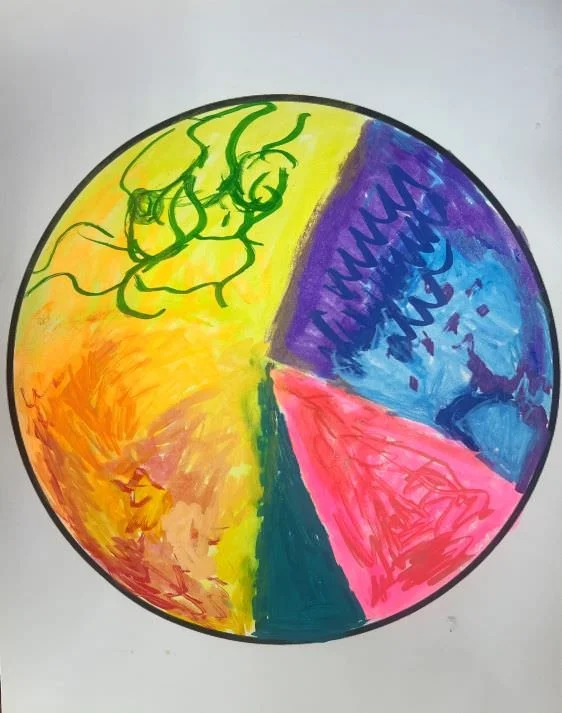
I used paint sticks and acrylic markers.
The pie chart prompt can be adapted to get even more specific to body image. I have asked clients to create a pie chart of their body image and to consider the different things that impact how they feel in their bodies. Some examples are social media, aging, cultural expectations, gender dysphoria or gender euphoria, clothing, friends, and food. I encourage people to think about how they feel about these different areas when choosing colors and images for each pie slice.
The pie chart intervention engages structured problem-solving, organization skills, and emotional expression, making it an approachable activity for people who may be apprehensive about making art. While artistic background isn’t needed to benefit from art therapy, structured tasks can feel less intimidating.
Make a Collage of the Media Messaging You Wish You Had
The messages we get about our bodies continue to be rooted in shame and the need to look a certain way to feel worthy. Societal standards affect everybody, but they especially hit hard for anyone who isn’t thin, white, and cisgender. Diet culture and fatphobia are so normalized that they’re baked into every book, movie, and advertisement that we see. I can’t tell you how many times I’ve seen “pro-weight loss examples” in therapy books, including some of the biggest names out there (cough Yalom cough). While many TV shows may not be balantly fat phobic, they are often lacking in representation when it comes to size diversity. People in larger bodies may want to see themselves as the main character in a series, or the primary love interest in a rom-com. Queer people often turn to books and fanfiction in order to see themselves more represented in stories.
There can be a feeling of grief that comes up with acknowledging the impact that diet culture has on us. We didn’t sign up for it, but it’s put on us time and time again. In the age of GLP-1s, many body-positive icons have turned to weight loss, which can bring up feelings of loss and even a sense of betrayal. While body diversity has always been a work in progress, it’s becoming even less visible in the media.
The prompt is to create a collage about what you want to see in the media, found in The Art of Body Acceptance. I encourage people to think about TV shows, movies, magazine articles, and social media. I promp people to explore colors and shapes that represent the emotions they feel when they imagine their ideal media.
After the artwork, we process together how the experience made them feel about their own body. The prompt can help clients shift their anger towards societal messaging that has harmed them, instead of blaming themselves. When we recognize the impact of these systems, we can stop asking ourselves, “What is wrong with me? “, and start asking “How can I cope with the injustice and take care of myself?” This prompt can be a wake-up call on the impact of social media, which can help people feel more motivated to set boundaries around how much time they spend on TikTok.
Draw Your Inner Critic
As an art therapist, I love helping my clients give shape to their inner critic and externalize it through the process of artmaking. We all have an inner critic that lives in our heads. Sometimes it sounds like someone we know, or it’s a completely new voice that mimics some of the painful things that have been said to us. It can be an inner mean girl, inner bully, or a critical authority figure. The inner critic is a big player in the eating disorder game and will often shame my clients for what they eat and how they look. It plays a huge role in body image and can be especially loud when clients see themselves in the mirror and in pictures.
I combine art therapy and IFS to help my clients explore their inner critic from a place of curiosity. First, we explore how they are sensing their inner critic in the therapy room. I guide my clients to notice the thoughts, feelings, and images that are coming when they are thinking of their inner critic. Some people notice it as body sensations while other people will see it as a color or a shape. We might brainstorm some ideas like using a fictional character, animal, or symbol that best represents their inner critic. Clients are offered a variety of art materials and directed to think about the use of line, shape, and color in their artwork.
Conclusion
Art therapy can help us face the most complicated feelings about our bodies in a way that is less threatening. It can help us discover new truths about ourselves that wouldn’t have been possible without images. We often don’t get the chance to truly externalize what’s going on in our heads, let alone make sense of it. As an art therapist and Certified Eating Disorder Specialist, I love helping queer and trans clients find their own inner peace through body image counseling. If that sounds like you, feel free to reach out and schedule a free consultation to see if we’re a good match.
References
Bennett, A. (2021). The art of body acceptance: Strengthen your relationship with yourself through therapeutic creative exercises.
Jacobson-Levy, M., & Foy-Tornay, M. (2010). Finding your voice through creativity: The art and journaling workbook for disordered eating.
